
That's La Plagne contains affiliate links and is a member of the Amazon affiliate program. If you make a purchase using one of these links, I may receive a small commission - at no extra cost to you. I never recommend anything I haven't experienced myself, and the commission helps me keep this site running at full speed! See my Disclosure Policy for extra information.
The La Plagne cheese farm: a behind-the-scenes visit to the La Plagne fromagerie
Visit the La Plagne cheese dairy & fromagerie: local cheese, fresh milk & mountain traditions
Most people come to La Plagne for the mountains, whether it's skiing in winter or exploring the alpine trails in summer. But those in the know KNOW that you also visit the Alps for the food! And some of our favourite memories have been made far away from the lifts, discovering the people and traditions that have shaped these mountains for generations.
Almost hidden away, just above La Plagne is a traditional mountain dairy, known locally as the fromagerie, where milk from cows grazing the alpine pastures around La Plagne is transformed into some of the region's most delicious cheeses. While Beaufort may be the best known, it's only part of the story.
A visit here isn't just about cheese. It's a chance to step inside a working dairy, watch skilled cheesemakers at work, learn how local milk becomes everything from Beaufort to Tomme de Savoie, and meet the people who keep these mountain traditions alive.
Before our visit, we'd enjoyed the cheese countless times, but seeing the journey from cow to cheese gave us a completely new appreciation for what goes into every wheel. Watching the afternoon milking, exploring the ageing rooms and chatting with the team reminded us that some of the most memorable experiences in La Plagne aren't found on a ski slope. They're found by slowing down and connecting with the people who call these mountains home.
Whether you're looking for an authentic family activity, want to buy the freshest local produce, or are simply curious about where your food comes from, the La Plagne cheese farm is one of those places that offers a different perspective on mountain life. And if you leave with a bag full of local cheese, a bottle of fresh milk and a few recommendations from the farm shop, all the better.
Why visit the La Plagne cheese dairy?
If you're looking for the most authentic local experience in La Plagne, we'd put this near the top of the list.
While many visitors enjoy Beaufort and other local cheeses during their holiday, very few get to see where they actually come from. A visit to the fromagerie takes you behind the scenes of a working mountain dairy, where milk from cows grazing the alpine pastures around La Plagne is transformed into some of the region's most loved cheeses.
It's a completely different side of mountain life.
Instead of ski lifts and busy pistes, you'll find farmers arriving with fresh milk, cheesemakers carefully following techniques that have been passed down through generations, and shelves lined with cheeses slowly maturing before they make their way onto dinner tables across France and beyond.
For families, it's a wonderful way to help children understand where food comes from. Watching the cows being milked, seeing fresh milk become cheese and meeting the people behind the process makes something as ordinary as a piece of cheese feel much more meaningful.
But it's not just about learning. It's about slowing down.
Taking the time to chat with local producers. Asking questions. Discovering the care that goes into every stage of the process. Leaving with a better understanding of the mountains and the people who have shaped them for generations.
Of course, no visit is complete without stopping at the little farm shop before you leave.
Alongside the famous Beaufort, you'll find Tomme de Savoie, fresh dairy products, local honey, charcuterie, wines, fruit juices and other regional specialities. You can even fill your own bottle with fresh milk straight from the dairy – one of those simple experiences our children always remember.
For us, that's what makes this place so special.
It's not simply somewhere to buy cheese.
It's somewhere that helps you connect with La Plagne in a way that most visitors never experience.
Meet the people behind the cheese
Meet the People Behind the Cheese
One of the things we love most about visiting the fromagerie is that you don't just learn about cheese. You meet the people who make it possible.
Every wheel of cheese begins long before it reaches the dairy. It starts high on the alpine slopes around La Plagne, where local farmers care for their herds throughout the changing mountain seasons.
The fromagerie works as a cooperative, bringing together several local farming families with a shared goal: producing exceptional mountain cheese while preserving traditional farming in the Tarentaise Valley. Together, they collect milk from more than 600 Tarine and Abondance cows grazing across around 3,000 hectares of alpine pasture surrounding La Plagne.
To care for the cows, the herd is divided between three alpine pastures, each looked after by its own team of shepherds.
Around Plagne Centre, you'll find Lucas, Jérémy and Mickael caring for the Plagne Centre flock. Higher up on the Arpette slopes, Maxence, Théo and Hugo look after the Arpette herd. And if you head over the Col de Forcle towards the Bozelet Chapel, you'll come across the Forcle flock, where Jérémy, Christiana and Tom spend their summer with the cows.
These aren't just beautiful mountain landscapes for visitors to admire. They're working pastures, and the different grasses, herbs and wildflowers the cows graze throughout the summer all contribute to the flavour and character of the cheeses produced here.
It's a wonderful reminder that the landscape itself plays a part in every wheel of Beaufort.
We also met Marine, whose partner spends the summer making cheese here. She told us how they return to La Plagne each season while the cheesemaking is in full swing. It was a lovely reminder that this isn't simply a workplace, but a community built around the rhythms of mountain life. One conversation after another, you begin to realise that every person here plays a part in keeping these traditions alive.
By the end of the afternoon, we'd learnt far more than how cheese is made. We'd met the people who care for the cows, transform fresh mountain milk into cheese and keep these traditions alive for future generations. That's what makes a visit to the fromagerie feel so special.
How La Plagne Beaufort cheese made
Although the fromagerie produces a wonderful range of local cheeses and fresh dairy products, Beaufort is undoubtedly its signature cheese. And seeing it made is one of the highlights of a visit.
Known as the “Prince of Gruyères”, Beaufort has been produced in the Savoie mountains for centuries and is protected by an Appellation d'Origine Protégée (AOP). That means every wheel must follow strict traditional methods, using milk from only Tarine and Abondance cows grazing within the designated Alpine region.
As Jeanne explained during our visit, it's only when you stand beside the vats and watch the process unfold that you begin to appreciate just how much work goes into every wheel.
It all starts with fresh mountain milk
The journey begins with fresh milk collected from local farms around La Plagne.
Because the milk travels only a short distance from the cows to the dairy, cheesemaking can begin while it's still incredibly fresh. A key part of producing high-quality Beaufort.
Standing beside the enormous copper vats, it's hard to imagine the scale of what's happening. Jeanne told us that each wheel of Beaufort weighs around 40kg and requires an incredible 400 litres of milk to produce. It certainly made us appreciate every slice a little more!
From milk to curds
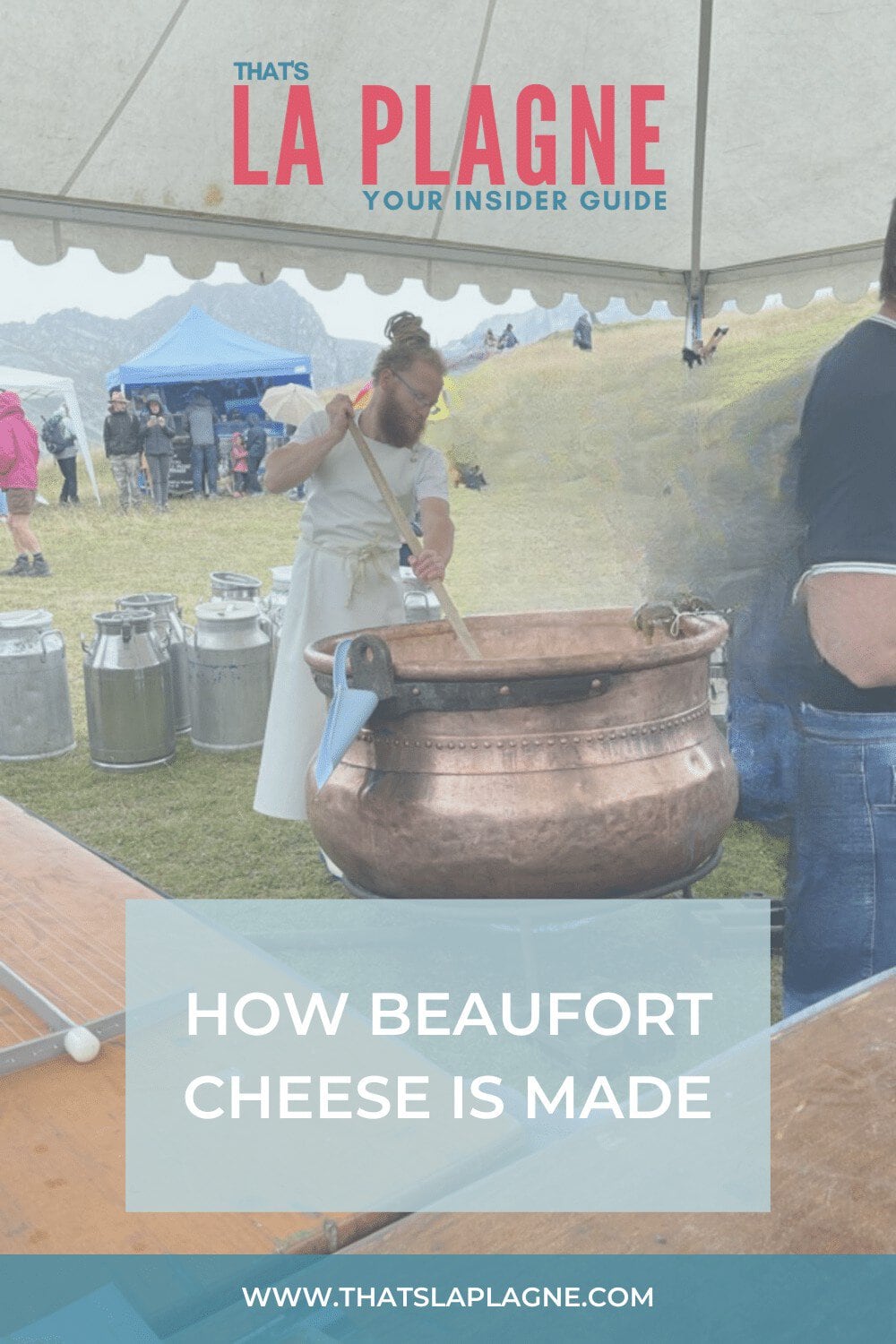
The milk is gently heated before natural cultures and rennet are added, allowing it to slowly thicken into curds.
The curds are then carefully cut into tiny pieces before being stirred and heated again. Every stage is carefully monitored, with years of experience guiding the process as much as the equipment itself.
Watching the cheesemakers at work is surprisingly calming. There's no rushing. Just quiet concentration and craftsmanship that's been passed down through generations.
Pressing the cheese
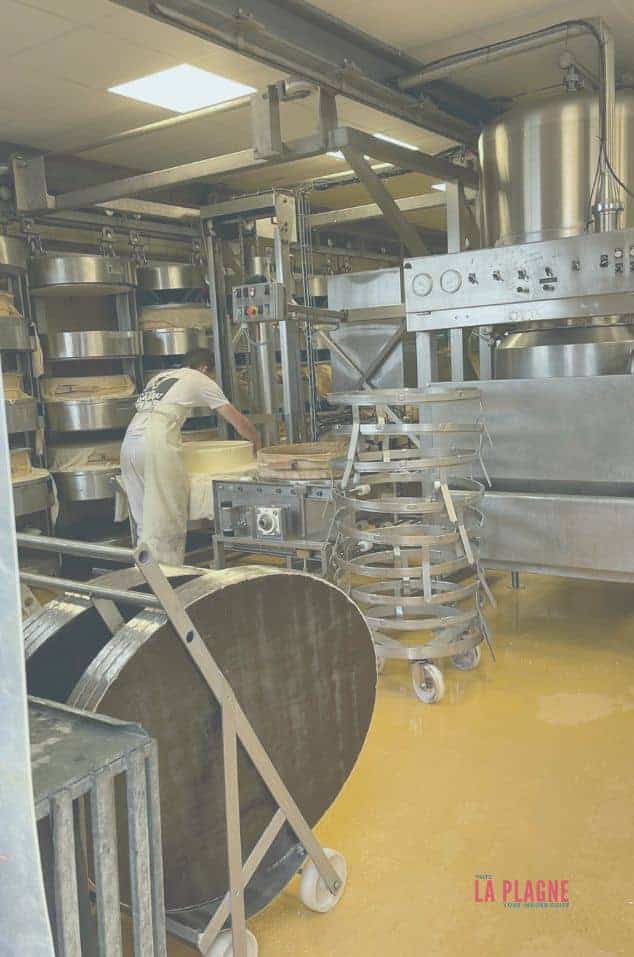
Once the curds are ready, they're transferred into large moulds and pressed to remove the remaining whey.
This gives Beaufort its distinctive concave edge, which is one of the easiest ways to recognise it.
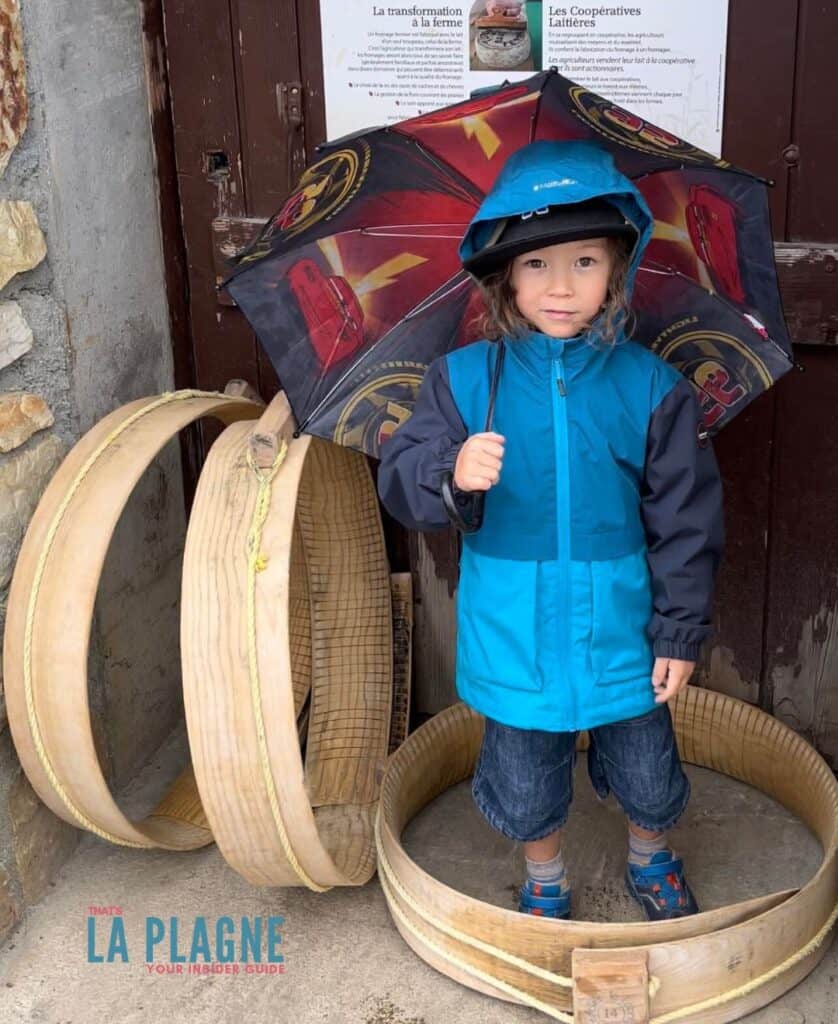
A dip in salt water
Before the wheels begin their long ageing process, they're lowered into large salt-water baths.
The salt helps form the rind, protects the cheese as it matures and plays an important role in developing Beaufort's flavour.
It was one of the boys' favourite parts of the tour. Seeing these enormous 40kg wheels beneath the water in huge baths wasn't something they'd expected to see, and it quickly became one of those little moments they kept talking about afterward.
Time is the secret ingredient
Once they've been removed from the salt baths, the wheels are transferred to carefully controlled ageing rooms, where they'll spend at least 5 months developing their rich, complex flavour.
During this time they're regularly turned, brushed and checked to ensure every wheel matures perfectly.
Walking into the ageing room is one of the most memorable parts of the visit. Row upon row of enormous wheels quietly mature on wooden shelves, each one slowly changing over time.
Not all Beaufort is the same
One of the most interesting things we learnt was that there are actually three different types of Beaufort.
- Beaufort d'été (Summer Beaufort) is made when the cows are grazing the high alpine pastures, feeding on a rich variety of grasses and wildflowers. This gives the cheese a more complex and aromatic flavour.
- Beaufort d'hiver (Winter Beaufort) is produced when the cows are fed on hay during the colder months, resulting in a different but equally delicious flavour profile.
- Beaufort Chalet d'Alpage is the rarest of all. Produced in small quantities high in the mountains, it's made entirely by hand without machinery using traditional methods. This special cheese isn't produced at the La Plagne fromagerie, but it's a wonderful example of the craftsmanship that has made Beaufort famous throughout the Alps.
Seeing it made changes everything
Before visiting the fromagerie, we'd enjoyed plenty of Beaufort over the years.
But seeing the fresh milk arrive, learning just how much goes into every wheel and meeting the people behind the process gave us a completely new appreciation for it.
The next time we sat down with a piece of Beaufort, we weren't just tasting cheese.
We were remembering the cows grazing the mountain pastures, the cheesemakers patiently guiding every stage of the process and the traditions that continue to shape life in La Plagne today.
🧀 Did you know?
Each wheel of Beaufort weighs around 40kg and requires approximately 400 litres of fresh mountain milk to produce. Before ageing, every wheel is immersed in a salt-water bath to help develop its rind and flavour.
More than just Beaufort
Although Beaufort is the cheese most people associate with the Savoie region, it's far from the only thing you'll discover at the La Plagne fromagerie.
The dairy produces a wonderful selection of local cheeses, each with its own character and flavour. Alongside Beaufort, you'll find Tomme de Savoie, a firm favourite in our house. It's milder than Beaufort and has become the boys' cheese of choice whenever we put together a mountain picnic or cheeseboard.
You'll also find butter, creamy goat's cheese, sheep's cheese, cottage cheese and rich (but runny!) crème fraîche, all made using the same care and respect for traditional methods.
It's easy to arrive thinking you'll buy a piece of Beaufort to take home.
If you're anything like us, you'll leave with a bag full of local produce you hadn't planned on trying!
Fresh milk straight from the dairy
One of our favourite discoveries at the fromagerie wasn't actually the cheese. It was the fresh milk.
Bring along a clean bottle and they can fill it straight from the milk dispenser. Knowing it had come from the very cows we'd just met out on the mountain somehow made it taste even better.
Our two-year-old absolutely loved it. Between my three children, they polished off one and a half litres in less than two days. It quickly became the drink they asked for with breakfast and after a day exploring the mountains.
We couldn't resist bringing home a couple of pats of butter too. Every morning since, I've been spreading it onto a fresh baguette while looking out of the window at the very slopes where the cows had been grazing. It's one of those simple little rituals that brings you back to your holiday long after you've left.
What to expect on your visit
One of the things we loved most about visiting the fromagerie was that it never felt like a polished tourist attraction. It's rough and ready – and real, as my nan would say! It felt like being welcomed into a place where people are simply getting on with their day – and making cheese!
Your visit begins with a warm welcome from Jeanne, with a short talk about the procedures and what makes Beaufort Beaufort. We listened in French, but she can also do it in English. Then it's time to head behind the scenes to discover how milk from local herds is transformed into Beaufort and the other cheeses produced here. Along the way, you'll learn about the different breeds of cows, why Alpine pastures are so important and how the changing seasons influence the flavour of the cheese.
Inside the dairy, you'll see the impressive copper vats where the cheesemaking begins, watch the different stages of production and, if you're lucky, catch the cheesemakers at work. It's fascinating to see just how much care goes into every step.
For many visitors, the ageing cellar is a real highlight. Walking into the cool room lined with enormous wheels of Beaufort quietly maturing on wooden shelves is a moment that makes you stop and take it all in.
Before you leave, don't forget to spend some time in the farm shop. Whether you're filling a bottle with fresh milk, choosing a piece of Beaufort or picking up local honey, charcuterie or wine, it's the perfect way to take a little taste of La Plagne home with you.
Visiting with children
If you're wondering whether a cheese dairy tour will keep children entertained, we had exactly the same question before our first visit.
The answer? Absolutely.
What surprised us most was how hands-on and engaging the experience felt. Rather than simply listening to someone talk about cheese, the children were constantly spotting something new, watching the cows, peering into the huge copper vats, seeing the enormous Beaufort wheels soaking in their salt baths and exploring the ageing cellar lined with shelves of cheese.
Our boys loved learning how milk becomes cheese, especially when Jeanne explained that each 40kg wheel of Beaufort requires around 400 litres of milk. It was one of those facts that really stuck with them.
Phoenix, my 8-year-old, did ask if they were making Mozarella and was disappointed to learn there was no mozzarella on site…
Meanwhile, our two-year-old was quite happy making friends with the cows and, afterwards, enthusiastically taste-testing the fresh milk from the farm shop. Safe to say it got her seal of approval!
For families visiting La Plagne, it's a lovely change of pace from the usual mountain activities. It's also the kind of activity that naturally sparks conversations afterwards. On the journey home we found ourselves chatting about farming, the changing seasons, where food comes from and why mountain traditions like this are still so important today.
Plan your visit
If you're looking for an authentic family-friendly experience in La Plagne, a visit to the fromagerie is well worth adding to your holiday plans.
Guided Visit
The guided tour takes place every Wednesday at 5:30pm (17:30) and offers a fascinating insight into how Beaufort and other local cheeses are made.
As the cows spend their summers grazing high on the mountain, the schedule can occasionally change if the weather is particularly stormy. We recommend checking the fromagerie's social media before setting off, just in case the visit has been moved to another day.
Farm shop opening hours
Even if you can't make the guided tour, the farm shop is open every day, making it easy to stop by and stock up on local produce.
Opening hours:
- 10:00 – 12:30
- 15:00 – 19:00
Whether you're picking up a wedge of Beaufort, filling a bottle with fresh milk or choosing a few local treats to take home, it's well worth a visit.
Don't forget! Before you go:
- Bring a clean bottle if you'd like to buy fresh milk.
- Arrive a few minutes early for the Wednesday tour.
- Check the fromagerie's social media if stormy weather is forecast, as the tour day may occasionally change.
- Leave a little extra time to browse the farm shop. You'll almost certainly leave with more than you planned!
Pin this post to save for when you need it
The first thing you need is this
Get my La Plagne deals straight to your inbox:
- Transfer codes
- Accommodation deals
- Ski lesson sales
- Ski hire offers

One Comment