
That's La Plagne contains affiliate links and is a member of the Amazon affiliate program. If you make a purchase using one of these links, I may receive a small commission - at no extra cost to you. I never recommend anything I haven't experienced myself, and the commission helps me keep this site running at full speed! See my Disclosure Policy for extra information.
Ski safety in La Plagne: what families should actually know
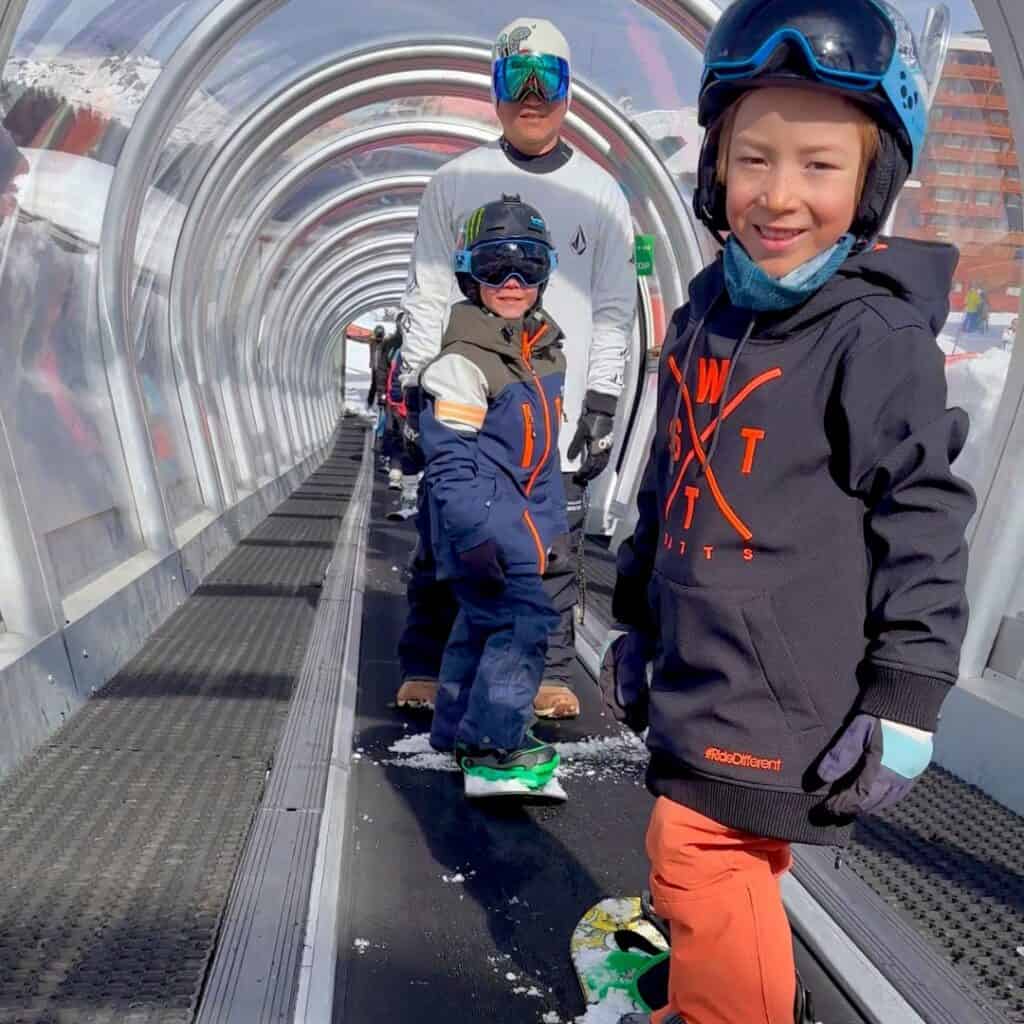
Ski safety in La Plagne: are we focusing on the wrong things?
La Plagne is making a fairly dramatic change to piste safety this winter.
Around 80% of the familiar safety banners across the ski area are being removed.
At first glance, that sounds like exactly the opposite of what you would do if you wanted people to ski more safely.
But the reasoning behind it has made me think much more broadly about ski safety.
Because when we talk about keeping ourselves and our children safe on the mountain, we tend to focus on the obvious things.
- Helmets.
- Piste signs.
- Ski level.
- Equipment.
- Whether your child can stop.
All important.
But after years of skiing here, and particularly after years of skiing with my own children, I think one of the biggest risks is something none of those things can entirely protect you from.
Other skiers.
And that is really what this post is about.
Why is La Plagne removing so many safety banners?
For winter 2026/27, La Plagne is removing around 80% of the banners currently used to warn skiers about hazards.
The resort's piste team says the problem is that there are now so many banners that skiers have become used to seeing them.
Instead of attracting attention, they can start to blend into the background.
The replacement system uses fewer triangular signs, inspired by road signs, positioned around specific hazards such as piste crossings or icy sections.
The aim is not less safety information.
It is fewer warnings, placed where people are more likely to actually notice them.
La Plagne says the system was tested during winter 2025/26 before the wider rollout this season.
And I can see the logic.
If everything is marked as important, eventually nothing feels particularly important.
But will fewer signs actually work?
This is the bit I want to see for myself.
Not on a plan.
Not in a press release.
On a busy piste in February.
Because skiing with children makes you look at a piste very differently.
When I ski on my own, I can concentrate mainly on what I am doing.
With the children, I'm constantly scanning.
- Where are they?
- Who is behind them?
- Are we approaching a crossing?
- Has somebody stopped just underneath that roller?
- Is one child suddenly about to traverse the entire piste without checking uphill?
- Has the skier coming down behind us realised there are children ahead?
There is a lot going on.
So yes, reducing visual clutter could make important signs much easier to spot.
But those signs also need to be immediately understandable when you're moving, distracted and sharing the piste with dozens of other people.
I'll be particularly interested to see whether my kids notice the new signage without me pointing it out.
That feels like quite a good test.
The number that bothered me most was 50 km/h
There are several interesting figures in La Plagne's latest safety information.
The resort says accidents on its pistes fell by 2% during winter 2025/26.
It also says around 10% of piste accidents are collisions.
But this was the statistic that really made me stop:
50 km/h.
That is the average speed La Plagne gives for a skier on a blue piste.
Now think about who you find on a blue piste.
- Children.
- Beginner adults.
- Ski-school groups.
- People building confidence after their first few days.
- Families skiing together.
- Intermediate skiers cruising.
- Very strong skiers simply using the blue as the easiest route across the mountain.
All sharing the same piece of snow.
A blue piste tells you about the technical difficulty of the terrain.
It does not mean the people around you are moving slowly.
You can teach your kids to ski safely, but you cannot control everybody else
This is probably the biggest shift in how I think about ski safety since becoming a parent.
There is a lot I can teach my children.
- Look uphill before setting off.
- Don't stop in the middle of a piste.
- Don't sit underneath a roller where nobody can see you.
- Leave space.
- Slow down at crossings.
- Don't weave unpredictably across a busy piste without looking.
- Stop somewhere visible at the side.
All very important, and all consistent with the French government's current piste-safety guidance, and with the Piste X Code, which we love and use (more on that below). Both specifically tell skiers to adapt their speed, keep a safe distance, slow down at crossings, pay attention to children and beginners and stop somewhere visible at the edge of the piste.
But I cannot control the person behind my child.
That is why I think ski safety is much more collective than we often acknowledge.
The Piste X Code: a fun way to teach kids the rules
One of the easiest ways to start these conversations with children is the Piste X Code. It was created by two Morzine ski mums, Amie and Louise, as a modern, family-friendly version of the classic ski safety rules, in both French and English. I was proud to be its ambassador in La Plagne.
Its mascot is Monty, a blue yeti, and his catchphrase is “Stop. Look. Slide!”. It’s simple enough for little ones to remember, and it covers exactly the things I worry about most: looking uphill before you set off, stopping somewhere visible and leaving space for others.
Sit down and watch the short Piste X Code video with your kids before your holiday, then test the whole family with the 10-question Piste X Code ski safety quiz.
Skiing feels individual, but it really isn't
La Plagne's piste director, Rémi Devidal, makes an interesting point in the winter 2026/27 information.
We treat skiing as an individual sport, but everybody is effectively playing on the same pitch:
- I choose my speed.
- You choose yours.
- My child chooses a line.
- Somebody else decides when to overtake.
And all of those decisions interact.
There isn't a seatbelt or airbag separating us.
I think that is one of the most useful ways to talk to children about piste safety too.
It isn't simply:
“Don't fall over.”
It is:
“Think about what your skiing is doing to the people around you.”
A helmet is important, but it doesn't make you a safe skier
I am absolutely pro-helmet.
My children wear them.
I wear one.
French government advice strongly recommends helmets for skiing and says research has shown them to reduce the risk of head trauma, particularly among children.
Helmet use among adults is already very high too.
La Plagne's figures put average adult helmet use in 2024/25 at around 90% for French skiers and 95% for foreign skiers.
But I think helmets have become an easy shorthand for ski safety.
You can put a helmet on and still ski far too fast for the conditions.
You can wear one and overtake a nervous skier with centimetres to spare.
You can wear one and stop underneath a blind roller.
You can wear one and launch yourself straight back onto a piste without checking uphill.
A helmet protects your head when something has already gone wrong.
It doesn't replace good judgement.
Italy has gone much further on helmets
From the 2025/26 ski season, Italy made helmets compulsory for everyone using its ski areas, including adults.
Italian police have already been enforcing the rule, with sanctions for skiers found without helmets and the possibility of ski-pass withdrawal for repeat offences.
France currently takes a different approach.
The French Ministry of Sport strongly recommends wearing a ski helmet, particularly for children, but its national safety guidance focuses more broadly on preparation, equipment, speed, awareness and behaviour.
I'm interested to see whether France eventually follows Italy.
But I also don't think making helmets compulsory would solve the whole problem.
Because the skier who worries me most when I'm with my children isn't necessarily the person without a helmet.
It's the person travelling far too quickly, out of control, through a crowded area.
Leading by example matters
This part is more personal.
Children look at experienced skiers and decide that is what good skiing looks like.
Beginners do the same.
And we naturally assume instructors, guides and mountain professionals are modelling the behaviour we should follow.
I've personally skied with very experienced mountain professionals who made safety choices I wouldn't make myself.
On one off-piste lesson last winter, for example, the guide I was skiing with chose not to wear a helmet.
His view was essentially that his experience meant he knew how to fall.
That really stayed with me.
Not because I think wearing a helmet automatically makes somebody responsible.
And not because I think years of mountain experience count for nothing.
But because of the message it sends.
If we want children and less experienced skiers to take safety seriously, I think the strongest skiers on the mountain have an opportunity to model that behaviour.
Saying “I'm experienced enough not to need that” is quite a different message from “I'm experienced, and I still take precautions.”
That doesn't need to become a witch hunt about individual instructors or ski schools.
It is a wider mountain-culture question.
What does good skiing look like?
Good skiing isn't the same as fast skiing
This is another thing I think is worth teaching children early: A good skier isn't simply somebody who can go very fast.
- A good skier can change their speed.
- They can react to the person in front of them.
- They can ski a crowded blue differently from an empty piste.
- They can pass a nervous beginner without frightening them.
- They can approach a junction expecting somebody else to do something unpredictable.
- They can recognise when visibility, snow conditions or fatigue mean the sensible choice is to slow down.
For me, that is a much better definition of control than simply being able to ski quickly.
What I'll be watching in La Plagne this winter
The new safety signage gives us a useful real-life experiment.
I want to see:
- Do I notice the triangular signs sooner?
- Do my children understand them?
- Do junctions feel visually clearer?
- Do the warnings stand out on busy days?
- Does less piste furniture make skiing through those areas easier?
And, perhaps most importantly, does skier behaviour actually change?
Because the signs can only do so much.
So are we focusing on the wrong things?
Not entirely.
Helmets matter.
Signs matter.
Well-maintained equipment matters.
Lessons matter.
Choosing the right piste matters.
But I think ski safety conversations become too narrow when they stop there.
The person skiing downhill has choices too.
How fast to go.
How much room to leave.
When to overtake.
Where to stop.
Whether to slow down around a group of children.
Whether to treat a busy blue piste like a racetrack simply because they have the ability to ski it quickly.
For families, that shared responsibility matters enormously.
I can put every piece of protective equipment imaginable on my children.
What I can't put around them is an invisible barrier that stops another skier hitting them.
So perhaps the most useful safety message isn't:
“Protect yourself.”
Maybe it's:
“Remember there are other people here too.”
That is the part of La Plagne's new safety conversation I hope doesn't get lost behind the story about removing 80% of the banners.
Because fewer signs might make us look up.
But ultimately, we still need to look out for each other.
More on skiing safely with kids
If you’re heading out with children, my guide to what to do if your child gets lost on the ski slopes covers meeting points, ID cards and a plan your kids will remember. You’ll find all my safety posts on the ski safety for families page, and the new signs are just one of the changes this season in what’s new in La Plagne for winter 2026/27.
See you on the slopes!
Source note
The La Plagne-specific figures and new signage information in this article come from La Plagne's official winter 2026/27 press information.
France's wider piste-safety and helmet guidance comes from the French Ministry of Sport and its 2026 national RISKI ski-safety campaign.
The Italy helmet comparison reflects the rules in force from the 2025/26 winter season, when helmets became compulsory for adult skiers as well as children.
